
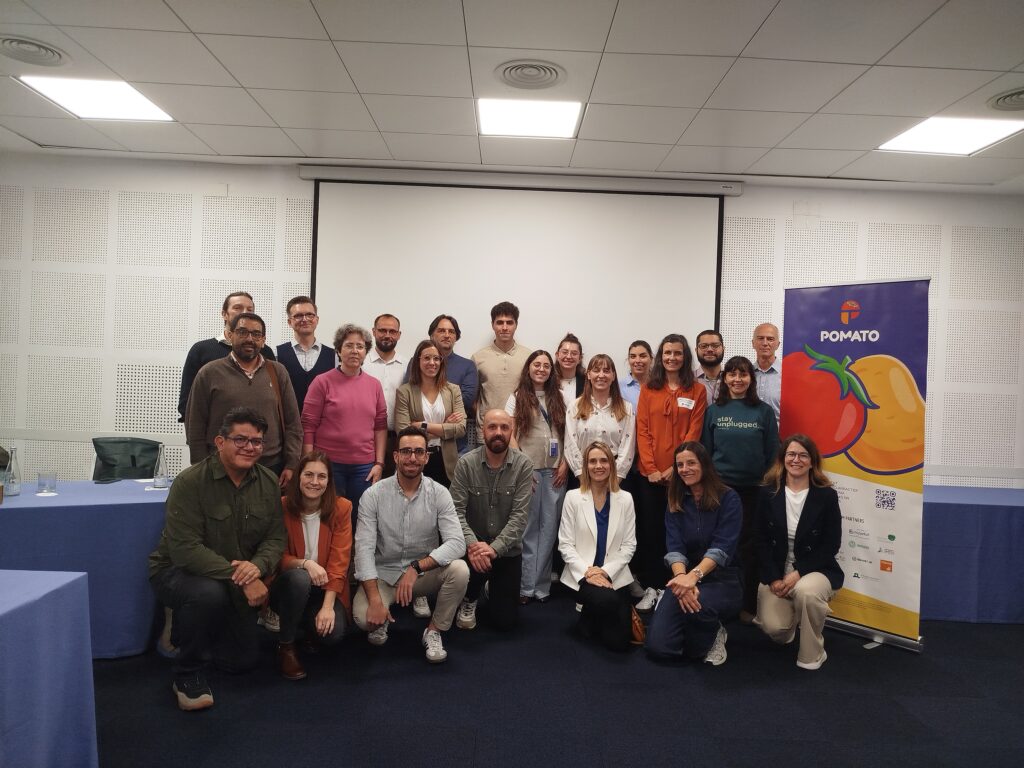
The POMATO consortium gathered in Lisbon, Portugal, for the project’s Month 12 General Assembly, hosted by Food4Sustainability. The two-day hybrid meeting brought together partners on-site and online to review the scientific, technical, administrative, dissemination and stakeholder engagement progress achieved during the first year of the project.
POMATO, funded under Horizon Europe, is developing effective management strategies to tackle Clavibacter sepedonicus and Ralstonia solanacearum outbreaks in potato and tomato crops. By combining pathogen characterisation, artificial intelligence, early detection tools, smart sensors, natural and biological control solutions, and Integrated Pest Management strategies, the project aims to support more resilient and sustainable crop production systems in Europe and Latin America.
During the General Assembly, partners presented the main results achieved across the project’s work packages during the first implementation year. Discussions focused on progress in pathogen isolation and characterisation, the development of AI-based surveillance and disease prediction tools, advances in smart polymeric sensors for early detection, and promising preliminary results related to natural and biological control solutions.
The consortium also reviewed the project’s future validation strategy, including the preparation of greenhouse and field validation activities. These future steps will be essential to assess the most promising POMATO technologies under real agricultural conditions and to support the development of practical recommendations for growers and stakeholders.
Reflecting on the value of in-person meetings, Saúl Vallejos Calzada, University of Burgos, POMATO project Co-Principal Investigator, highlighted the importance of face-to-face General Assemblies for strengthening collaboration across the consortium: “In-person General Assemblies bring very important added value to the project. They allow us not only to discuss current work packages and tasks, but also to exchange new ideas that may inspire future cooperation and future projects.”
The meeting also provided an opportunity to reflect on the achievements of POMATO’s first year. Cintia Virumbrales Ortiz, University of Burgos, POMATO project Co-Principal Investigator, emphasised the strong alignment of partners with the project timeline and the encouraging progress made so far:“During this first year of the POMATO project, all partners have worked very well and remained aligned with the project timeline. Significant progress has been achieved in pathogen isolation and characterisation, the development of sensor and AI-based tools, and the identification of promising biosolutions against both pathogens in potato and tomato crops.”
Looking ahead, POMATO will continue developing and improving its technologies, with a focus on enhancing pathogen characterisation, advancing AI and sensor-based tools, and further assessing the most promising biological control solutions. The project’s long-term goal is to validate these approaches under greenhouse and field conditions and integrate them into practical Integrated Pest Management strategies.
The Lisbon General Assembly was considered a productive milestone for the consortium, supporting stronger technical collaboration, alignment between work packages, and preparation for the next implementation period of the project.
Discover more about the project at www.pomato.eu
